Phil Hansen Strokes of Genius
Phil Hansen is not only tearing down the “gallery” walls that keep many people from seeing and enjoying art. He’s also showing us how it’s made -- all on the Internet.
People of the Web Weird Art to see his Featured Video showing how he works and explains his art!
Phil Hansen stubbornly adheres to one artistic cliche. He's willing to suffer for his art.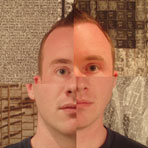
Asked to provide a photo for Yahoo! News, Phil Hansen couldn't resist creating a composite image.
Take the giant portrait he made of North Korean leader Kim Jong Il as a protest against nuclear proliferation. He applied 6,000 adhesive bandages on a plywood backdrop. Then, using a quart-sized bag of his own blood, he painted Kim's face on the exposed gauze. His sister-in-law, a doctor, helped him draw the 500ml he needed.
Hansen shrugs off the experience.
"Five hundred cc's of blood seems like a lot, but it's just nothing," he says from the basement of his brother's house outside St. Paul, Minnesota, where he currently lives and makes his art. "I don't even have scars on my arms anymore from it."
It's not the suffering that really distinguishes Hansen's work (after all, it's hard to top Van Gogh) but his style and method for displaying it. Hansen eschews galleries, preferring to take his art directly to the eyeballs rather than bringing the eyeballs to the art — through the Internet.
An art school dropout, Hansen works as an X-ray technician by day, spending all of his spare time and money on his art. But his work, and his method of presenting it, has given him a huge audience.
His breakthrough piece was a time-lapse video of a two-day project called "Influences." He painted 30 pictures on his own chest, one over the other, with each picture representing an influence in his life. When he was done, he peeled the quarter-inch thick layer of paint from his skin and cut out a silhouette of his own profile. The video was streamed more than a million times on the Web — a cyber art phenomenon in which both process and final piece were revealed.
Hansen often uses the technique of pointillism, in which the canvas is dabbed with tiny bits of color, rather than fluid brush strokes, to create a larger image.
But he gives pointillism a modern twist. You might call it "kinetic fragmentism" — pointillism in motion.
For instance, Hansen completed an on-camera piece of paint-dipped karate chops to reveal a portrait of martial arts legend Bruce Lee.
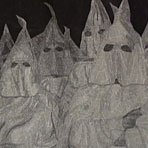
Hansen's Ku Klux Klan piece aims to provoke questions about religion.
His works often have a political stance. Several years ago, Hansen devised an image of President George W. Bush by hand-painting the names of 1,700 coalition soldiers killed from the beginning of the Iraq War until April 2005.
"They're dying for George Bush," he explains. "They're dying for an idea that he had and unfortunately it wasn't a clear idea."
Covering the entire back wall of his brother's basement is a 7 x 14 foot mural of the Ku Klux Klan, made up from thousands of verses copied from the bible and individually cut out. It's a companion piece to an image of civil rights hero Rosa Parks — also made from bible verses.
Hansen says the idea was to show the far-reaching influences of religion for both evil and good.
Hansen's commitment to his own brand of pointillism is most evident in a portrait of the so-called Green River killer, Gary Ridgeway.
He made the piece by drawing one-inch portraits of each of Ridgeway's 48 female victims in various shades of light and dark. He then photocopied the drawings and cut them out into 12,000 tiny squares which he arranged, one by one, to reveal the killer's face.
Hansen says it's about remembering the victims — women all connected by the misfortune of having crossed paths with Ridgeway. The project took four months.
The detail work has taken its toll. Hansen holds up his right hand to show me a twitch he says he's had since high school, when he was first introduced to pointillism and became obsessed with it.
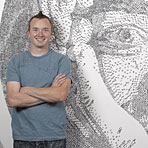
Hansen created his self-portrait 'A Moment' over the course of six days, oven sitting cross-legged for up to 12 hours straight.
His latest project used the Internet to connect his viewers to the art being created. He created a ten-foot, spinning, circular canvas in his brother's garage, then moved in there himself. Taking a week off work, he spent six days straight living in front of his web cam, sleeping on the floor, eating takeout and encouraging people to call him or email him with a "moment" that changed their lives.
"I'm really interested in how all of our experiences build together to create whatever world we live in," he said before starting the project.
He got over 600 responses. People from all over the world, from the United Kingdom to Romania to Botswana, told him their personal moments: their first time acting on stage; the death of a parent without being about to say goodbye; seeing the rainforest destroyed.
Starting from the center of the canvas, Hansen then painted their words, working out to the edges until the image they had collectively created was a face — Hansen's own — bordered by four hands.
"There's always someone or something, maybe even ourselves, supporting us," Hansen tells me by phone, shortly after completing the piece. "But at the same time there is some experience... trying to push us down. And somehow, as we move through life, most people end up kind of staying in the center, in the middle through that experience."
Strangely, Hansen says the jitter in his hand that has plagued him for so many years went away while he was making the piece.
-See more of Hansen's work at his Web site.
-Producer: Robert Padavick By KEVIN SITES, FRI JUL 13, 11:51 AM PDT
-Video Editor: Edo Brizio Average 1815 votes 
Permalink http://potw.news.yahoo.com/s/potw/23115/strokes-of-genius
Do you run a Web site you think we should feature? Do you know of a great story about the Web you think we should follow up on? Let us know.
Comments and Feedback: The Modern day de vinci!!!!! his work is amazing.  that's incrediable. Keep up the good work and don't give up. I enjoyed seeing your work. from lonely mom in texas.
  Phil - No more middle for you! I don't know who or what has 'tried' to push you down during your life, but you're done with that. You are phenominal and it's time for you to soar! Your talent, imagination, technique, and dedication are remarkable. I'm sure someone established in the art community will get behind you. This was my first introduction to you and your work on the internet. You can be sure I'll be looking for you in the future - I wish you the best! presedent Bush should let the trups come home..
  I would love to see some Salvador Dali,art by this guy,great stuff man,!! Dude,take your next tax return and head for Fance,or Euorope,where they appeciate great masters!!How a bout a Picaso of candy wrappers?LOVED your oringinallity!
  Give this guy his own damn studio, he is amazing.
Mr,Hanson, I hope everyone checks out your web site,the Moment,and the 1400 celcius art on the two by fo urs is incredible
posted by LadyIrene @ 10/16/2007 10:10:00 AM
0 comments