cc` !DOCTYPE html PUBLIC "-//W3C//DTD XHTML 1.0 Strict//EN" "http://www.w3.org/TR/xhtml1/DTD/xhtml1-strict.dtd"> My Dragon's Lair Sharing is the reason for my being...

My Dragon's Lair Sharing is the reason for my being...

Altered and added new content 10-4-07 Important 5-4-07 No longer Child safe because of the links inside sites included here. Adult Humor is posted here. Template errors still. E shows wrong, and Netscape shows mostly correct. Activly learning HTML to correct and improve. Be it fun or serious I hope you enjoy and take away with you what I find to share. LI

Sunday, November 04, 2007

Russian folk choreographer Moiseyev dies

Igor Moiseyev, the founder of the Moiseyev Dance Company, at a rehearsal in 1986.

By JACK ANDERSON

Igor Moiseyev, the master choreographer who created a new form of theatrical folk dance in Russia and whose troupe was one of the most popular dance companies of the 20th century, died yesterday in Moscow. He was 101. Alexander Zemlianichenko/Associated Press

Igor Moiseyev, a Russian choreographer, in 2006.

Daniel Mihailescu/Agence France-Presse — Getty Images

The company in performance in 2003.

His death, at a hospital where he had been unconscious for three days, was announced by the troupe’s director, Yelena Shcherbakova, the ITAR-Tass news agency reported. The Kremlin said that President Vladimir V. Putin expressed condolences.

The Moiseyev Dance Company’s energy, virtuosity, precision and ingenious distillation of folk styles from many lands set audiences cheering worldwide. When the troupe made its New York debut in 1958, presented by the impresario Sol Hurok at the Metropolitan Opera House, it became the first major Soviet dance group to perform in the United States. The visit helped usher in a new era of cultural exchange, formalized that year by an agreement signed by the United States and the Soviet Union.

John Martin, the dance critic of The New York Times, pronounced the New York debut “stupendous.” And Ed Sullivan gave the troupe national exposure during the same trip, presenting the dancers for a full hour on his television variety show, “Toast of the Town” (later renamed “The Ed Sullivan Show”).

Although Mr. Moiseyev’s choreography derived from folk sources, he created his works for professional dancers: as observers noted from the start, no peasants or villagers ever danced with such theatrical flair.

“Moiseyev is an astute folklorist and a good artist,” Mr. Martin wrote in 1958. “His company, 100 strong, is warm, vital, vivacious, remarkably trained, energetic beyond belief, and above all performers deluxe.”

Igor Aleksandrovich Moiseyev (pronounced moy-SAY-yeff) was born in Kiev, Ukraine, in 1906, the only child of a Russian lawyer and a French-Romanian seamstress. His family lived in Paris until he was 8, and throughout his life he spoke to Western journalists in fluent French.

After the family returned to Russia he studied ballet privately in Moscow, then entered the Bolshoi Ballet School in 1921. From 1924 to 1939 he was a member of the Bolshoi, sympathetic to the efforts of innovative Soviet choreographers of the 1920s and ’30s.

He developed his own interest in choreography, and his early ballets — among them “The Footballer” (1930), “Salammbô” (1932) and “Three Fat Men” (1935) — were noted for their experimentation, drama and characterization.

In 1936 Mr. Moiseyev was appointed dance director of the Moscow Theater of Folk Art, from which emerged, a year later, the Soviet Union’s first folk-dance ensemble. The troupe originally included many amateurs, but it soon employed professionally trained dancers. Officially known as the State Academic Folk Dance Ensemble of the Soviet Union, the troupe was usually billed in the West simply as the Moiseyev Dance Company.

Most of Mr. Moiseyev’s works were inspired by the traditions of the various regions in the Soviet Union. But he also created dances with Chinese, Cuban, Sicilian and Argentine themes, and in the early ’60s his dancers amused American audiences by performing the Virginia reel and a parody of rock ’n’ roll.

Mr. Moiseyev attributed his dancers’ virtuosity and versatility to their training in classical ballet, which he described in a 1970 interview as “the grammar of movement.”

“With ballet technique as a base,” he added, “one can do everything.”

He continued to work with traditional ballet companies throughout his career. In 1958, he staged his own version of “Spartacus” for the Bolshoi Ballet.

In addition to directing his folk ensemble, from 1967 to 1971 he headed a classical ballet troupe. Among its members were Alexander Filipov and Alexander Godunov, who both later joined American Ballet Theater in New York.

It was always Mr. Moiseyev’s folk dances that brought him international attention and acclaim. A favorite with audiences everywhere was the dramatic “Partisans,” which was both a tribute to Soviet guerrilla fighters in World War II and a technical tour de force that required dancers to imitate the gait of mounted soldiers whose “horses” were invisible under their cloaks.

The Moiseyev company consistently received critical acclaim. Yet as its repertory became familiar, the pioneering dancers of the original troupe were replaced by younger performers more concerned with technique than with motivating impulse. Reviewers began to notice limitations in the troupe’s aesthetic approach.

As a popular Soviet cultural export, the Moiseyev company was occasionally the target of American groups protesting Soviet policies. Most such demonstrations involved only picketing, but others turned violent. At a Moiseyev opening in September 1986, Russian members of the Jewish Defense League threw a tear gas canister into the audience at the Metropolitan Opera House, sending nearly 4,000 people streaming out of the hall.

Controversies also developed over the ideological content of Mr. Moiseyev’s work. Many Western critics found his happy folk to be in line with an accent on the positive required by Socialist Realism. A defender of expressive dramatic content in choreography, Mr. Moiseyev reiterated the dominant Soviet aesthetics of the cold war period when he deplored abstraction in ballet.

But Mr. Moiseyev, who refused to join the Communist Party, did more than parrot officially sanctioned views. In 1959 he was reprimanded by Soviet authorities for delivering a speech in which he maintained that American culture, far from being inherently decadent, was blessed with vigor. In 1967 he ruffled the Soviet authorities by asserting in a Pravda article that Soviet ballet was deadened by its preoccupation with princes and princesses and its unwillingness to tackle contemporary themes.

Mr. Moiseyev married the dancer Tamara Zeifert in 1940; she became his choreographic assistant. Other members of the company included their daughter, Olga Moiseyeva, and her husband, Boris Petrov. Mr. Moiseyev married a second time, and his wife is among his survivors, Ms. Shcherbakova said.

In poor health in recent years, he was rarely seen in public. But he appeared at a concert in Moscow last year to celebrate his 100th birthday. On his centenary, he received the Order of Merit, Russia’s highest civilian decoration. He had earlier been named People’s Artist of the U.S.S.R.. His other honors included the Dance Magazine Award in the United States, the Lenin Prize and three Stalin Prizes.

A creatively passionate man, Mr. Moiseyev said in a 1965 interview: “Everything I’ve done, I love. If you’re not in love, you can’t create. And if you’re calm when you’ve created something, you can rest assured that you’ve created nothing.”

Labels: , , ,

Thursday, November 01, 2007

Pygmy sperm whale beached in Vero Beach

Fort Pierce - A damaged heart killed a pygmy sperm whale that washed ashore this week in Vero Beach.
Preliminary results of a necropsy performed Wednesday by experts at the Harbor Branch Oceanographic Institution showed the animal died from heart failure known as cardiomyopathy. Humans face the same type of injury.
The creature's death was just the latest evidence suggesting how climate change and a host of other environmental stresses are affecting aquatic life, senior scientist Dr. Gregory Bossart said. And the noted researcher and marine mammal expert believes we might be next.

"One of our concerns is, this is a problem for these whales, but a lot of these whales are good sentinels for ocean health and also human health," Bossart said. "So what's impacting this whale could very easily be impacting us. So it's really in our own best interest to understand these problems. Our oceans are undergoing quite a bit of stress right now."
Bossart and a team of scientists have collected a growing swell of evidence during an ongoing health assessment of dolphins and other marine life in the Indian River Lagoon and oceans across the world.
In one of their latest papers published in the scientific journal Aquatic Mammals, the team found 48 percent of 30 whales studied between 1999 and 2006 suffered from cardiomyopathy.
More evidence came ashore Tuesday near the Rio Mar Sands condominium complex in Vero Beach.
Harbor Branch researchers immediately knew the whale had been sick for some time because it weighed only 655 pounds instead of a normal 1,200.
The weakened right side of the animal's heart and fluid-filled lungs confirmed the finding. Those are the same symptoms seen in humans with cardiomyopathy.
"That's a common thing we see in the emergency department," said Dr. Glenn Tremml, medical director of the emergency department at Indian River Medical Center.
Tremml, who assisted with the necropsy, said cardiomyopathy occurs when physical, chemical or viral factors damage the heart muscle that pumps blood to the lungs. When the heart fails, the lungs fill with a froth that drowns the animal.
"Most humans get cardiomyopathy from hypertension. When you have high blood pressure, it puts a lot of strain on the muscle, and the muscle eventually gives out," he said. "It's like, 'OK, start running.' Well eventually, you're going to give up, right? Your legs are going to give out."
And that, in a similar way, is what might be happening to the whales, according to Bossart's theory.
He thinks climate change and other factors have changed the location of the food supply, making it harder for the whales to find their diet of squid.
The harder they have to work for dinner, the more stress it puts on their hearts, which eventually give out.
And that's why it's so important for people to pay attention to what's going on in the oceans, Bossart said.
More articles By Gabriel Margasak Scripps Treasure Coast Newspapers
November 1, 2007

Whale Beached Again In Melbourne - Orlando News Story - WKMG Orlando 8/2003
During heavy downpours, four men held the pigmy whale steady while the bluish-gray creature wiggled about in the sand, just south of Spessard Holland Park.
www.local6.com/news/2404960/detail.html MELBOURNE BEACH -- A 7- to 8-foot whale that beached itself on the shore of a Melbourne, Fla., beach Thursday and then disappeared by into the surf has once again beached itself, according to Local 6 News.

Video
During heavy downpours, four men held the pigmy whale steady while the bluish-gray creature wiggled about in the sand, just south of Spessard Holland Park.

A rescue crew from SeaWorld was been called to attempt to help the whale that is beached at the 2900 block of State Road A1A in Melbourne Beach. However, the whale swam back out into the turbid ocean as state biologists and rescuers from SeaWorld arrived.

The whale, lying right-side up, had what appeared to be some slight scratches but otherwise appeared lively and alert, witnesses told Local 6 News partner Florida Today.

Pigmy whales, which can grow more than 12 feet long and weigh 600 pounds, usually die when they beach themselves.

"My guess is that it will come up again sometime tonight or tomorrow," Megan Stolen, a biologist for Hubbs-SeaWorld Research Institute in Orlando, said today. "So everybody's on standby until then."

Watch Local 6 News for more on this story. Copyright 2007 by Internet Broadcasting Systems and Local6.com. All rights reserved. This material may not be published, broadcast, rewritten or redistributed.

Photos from Aquatic Surari's Hawaiina Marine Life Pygmy Sperm Whale at Wikipedia.pygmy killer whale

dwarf spem whale

Labels: , ,

Tuesday, October 30, 2007

Croc Hunter's 'Sixth Sense' About Death

CANBERRA (Oct. 29) - Quirky crocodile hunter Steve Irwin had a sixth sense that he would die young, his American-born wife Terri said on Monday.
More than a year after the Khaki-clad naturalist died from a stingray's barb that pierced his heart, Terri Irwin told Australian television she had always tried to deflect her 44-year old husband's darker moments. A Risky Path
The Sacramento Bee / ZUMA Press

Did Steve Irwin know he was going to die young? His widow, Terri, says her 'Crocodile Hunter' husband was "open and honest" about his chances of dying while engaging in his life's work.

"He wasn't morbid about it, or awful about it, he was open and earnest about it. We've got to accomplish everything we can," she told Australian Broadcasting Corp. television's Enough Rope series. "Steve had a real sixth sense about so many things. He had an odd connection with wildlife. He was extraordinarily intuitive with people. I found it all very, I don't know if 'eerie' is the word, but remarkable, certainly."
Terri Irwin is writing a book about her life with her husband and said she had always tried to joke about Steve's premonition that he would die before he reached 40.
"I think that's an interesting angle, the risks that he took," she said in the interview broadcast on Monday.
"I would analyze that through our whole married life, and I have to tell you, I very infrequently worried about Steve with wildlife because he was that good.
"For him, the risks really in my mind were more the places he would travel, the modes of transportation, political unrest, disease risk, these sorts of things where he was filming."
She said Irwin became more aware of the risks he took with animals after having his first child Bindi, who now aims to carry on her father's wildlife legacy.
"He wanted to be here for the kids, and yet he always had that feeling something was going to happen early on," Terri said.
"He was such a frightening force of nature here on Earth. I'm sure he's out on his way to sink some Japanese whaling ships right now."

Labels: ,

Death Strikes 'Meerkat Manor' Again

Mozart, the troubled daughter of Flower, the late matriarch of the Whiskers clan on the popular Animal Planet series 'Meerkat Manor,' died at the end of Friday's episode; it was the second death to shake fans of the show's lovable but hard-luck stars in a month.
'Meerkat Manor' fans were saddened on Oct. 26 to learn of the demise of Mozart, who appeared to have fallen victim to a jackal.Mozart, the troubled daughter of Flower, the late matriarch of the Whiskers clan on the popular Animal Planet series 'Meerkat Manor,' died at the end of Friday's episode; it was the second death to shake fans of the show's lovable but hard-luck stars in a month. Photo Gallery: Mourning a Meerkat

Chad Henning, Animal Planet

'Meerkat Manor' fans were saddened on Oct. 26 to learn of the demise of Mozart, who appeared to have fallen victim to a jackal.
After Flower's death -- from a snake bite -- in the Sept. 28 episode, fans flooded the Internet with tributes in poem, picture and song. Early this week, as news of Mozart's demise leaked out, similar tributes began to crop up online.For the uninitiated, 'Meerkat Manor' traces the lives of the members of several colonies of meerkats in the Kalahari Desert of southern Africa as they procreate, fight for territory and scarce resources and race around looking as cute as all get-out. The Whiskers clan is part of a 13-year study that was originated by Cambridge University and has been followed on camera by producers from Animal Planet for the last three years.To the dismay of the show's more fervent fans, the life span of a Kalahari meerkat turns out to be not much different from that of the average soap opera villain. Despite calls from some fans after the death of Flowers for the repeal of the Darwinian laws of the desert, the producers have no such refinements in mind.
But they did learn something from the uproar created after the first season, when Shakespeare, a lovable scamp of a meerkat, disappeared and was presumed to have died. The producers place radio collars on each family's dominant female, the better to track the families' movements, but because Shakespeare, a male, simply went missing, there was no visual evidence of his demise. When Flower succumbed to snakebite, the radio collar let producers track her movements closely and provide viewers with visible closure.With Mozart, the cause of death was uncertain -- it was likely that she fell prey one night to a passing jackal, the show's narrator intones -- but viewers are shown her lifeless body, if from a tasteful distance. Although one meerkat looks much like another, the producers mark each animal with a strategically placed spot of hair dye to tell them apart.All is not lost, however. Fans of the show are likely to see more of Flower, and perhaps Mozart, in a feature film, 'Queen of the Kalahari,' tentatively scheduled for release next year. Copyright © 2007
The New York Times Company Chad Henning, Animal Planet LOS ANGELES, Oct. 27 Another tragedy has befallen the meerkats.

Labels:

Saturday, October 20, 2007

Taku: Killer whale at SeaWorld in Texas dies

SAN ANTONIO - A killer whale at the SeaWorld in San Antonio has died unexpectedly.
SeaWorld spokesman Fran Stephenson says Taku (tah-KU'), a 14-year-old male killer whale, died Wednesday night. Taku had been showing signs of infection for the three days before his death, but he was responding to treatment, Stephenson said.
A cause of death has not been determined. Results of an examination will be available in six weeks.
Stephenson said there is a wide disparity on estimates for the life expectancy of killer whales.


Taku died unexpectedly on October 17, 2007, at the age of 14 and weighing over 7000 lbs. Authorities said that a post-mortem examination will be performed, but results will not be available for six weeks.
Taku is a male killer whale, born at SeaWorld in Florida. After birth, he spent most of his time, being with Katina or Nyar, his half-sister. After 3 years of his mothers' care, she gave birth again. When his little sister was born he was very interested and since that moment they were inseparable! Mostly Unna, Katina and Taku were in a tank, doing laps together. On August 25, 2002 Katina gave birth again.

He became nervous and had to be moved into another tank. Unna was later moved to SeaWorld Texas in December of 2002 and since then, Ikaika and Taku started bonding. Ikaika even can swim in mother-calf-position with Taku.

Family Members/Breed

(Asterisk indicates a deceased relative)

Meeting Takara: When Takara and her daughter Kohana arrived at SeaWorld, Taku took some romantic interest in her. At first, Takara would swim away from him when he was too close to him but later took romantic interest in Taku and began to be close to him. Takara had made a good impression on Taku - love at first sight! Visitors were commenting on Taku's persistence in following Takara and Kohana everywhere after their arrival. Now things have settled down a bit and Takara actually enjoys Taku's company a lot. She would often initiate contact with him by swimming with him or just rubbing. They're a cute couple. Soon Taku mated with Takara in May 2004 and she became pregnant by him.

Birth of Taku's son Trua: On November 23, 2005 around 21:50 EST (4:50 PM), Takara went into labor with her second calf with her daughter Kohana beside her. An hour later around 22:22, Takara gave birth to a male calf (Taku's son/first calf) who was later to be named Trua. Source: Wikipedia

Orcas - SeaWorld's main attraction is its Orcas, several of which are housed in 7-million-gallon habitats that are each known as Shamu Stadium. Shamu was the name of the first Orca brought to SeaWorld San Diego in the 1960s. 'Shamu' is now used as a stage name for adult Orcas in performances at SeaWorld parks. The Orcas all have real names. Currently, Sea World houses 22 Orcas in its three parks. Seven Orcas live in the San Diego park: Corky, Kasatka, Ulises, Orkid, Sumar, Nakai, and Kalia. Nine live at SeaWorld Orlando: Katina, Kalina, Tilikum, Taima, Takara, Kayla, Trua, Nalani, and Malia. SeaWorld San Antonio holds six Orcas: Taku, Kyuquot, Keet, Unna, Tuar, and Halyn. Wikipedia History of SeaWorld

Dedicated to Taku on Webshots.com Taku published by orcalover109 Rest In Peace, Taku . . . I've uploaded some old pictures I had of Taku. I apologize for any duplicates. I chose this one for the dedication given. Photos and comments posted.

From Texas Liberal, a Wordpress Political site. The highlighted links show what is included.

An orca, or killer whale, has died unexpectedly today at Sea World in San Antonio, Texas. This whale was called Taku.

Taku is an interesting name for this whale. Gyotaku is a Japanese art form where an impression in paper made over a dead fish in order to preserve an image of the fish. In this way, fishermen could prove how big a catch they had made to others. It is also practiced by some as an art form.

The photo above is gyotaku art. Gyo means “fish” and taku means “rubbing or “impression.”

Of course, gyotaku is not what Sea World is doing with the deceased so-called Taku. Everybody already knows that Sea World puts huge killer whales in little tanks. Nothing to prove on that account.

Please click here for a previous Texas Liberal post on what is done with Shamu whales when they die at Sea World.

Please click here for a post on when a Shamu attacked her handler.

About Author: Neil Aquino. Since you’re at a political blog, please click here for a great article on helping America’s middle classes. We’ve got to find a way to help people live decent lives in the Global Economy. October 19th, 2007 - Posted by Neil Aquino Art, Sea Life, Texas , , , , , ,

Labels: , , , , ,

Wednesday, October 17, 2007

Staph Fatalities May Exceed AIDS Deaths

CHICAGO (Oct. 17) - More than 90,000 Americans get potentially deadly infections each year from a drug-resistant staph "superbug," the government reported in its first overall estimate of invasive disease caused by the germ.


An Invasive Disease

Jeanna Duerscherl, Roanoke Times / AP Students gather outside a high school Tuesday in Moneta, Va., after a classmate died of a drug-resistant staph infection. The death and student pressure led Bedford County to close its public schools for cleaning. 1 of 4 Photos
Deaths tied to these infections may exceed those caused by AIDS, said one public health expert commenting on the new study. Tuesday's report shows just how far one form of the staph germ has spread beyond its traditional hospital setting.

The overall incidence rate was about 32 invasive infections per 100,000 people. That's an "astounding" figure, said an editorial in Wednesday's Journal of the American Medical Association, which published the study.

Most drug-resistant staph cases are mild skin infections. But this study focused on invasive infections - those that enter the bloodstream or destroy flesh and can turn deadly.

Researchers found that only about one-quarter involved hospitalized patients. However, more than half were in the health care system - people who had recently had surgery or were on kidney dialysis, for example. Open wounds and exposure to medical equipment are major ways the bug spreads.

In recent years, the resistant germ has become more common in hospitals and it has been spreading through prisons, gyms and locker rooms, and in poor urban neighborhoods.

The new study offers the broadest look yet at the pervasiveness of the most severe infections caused by the bug, called methicillin-resistant Staphylococcus aureus, or MRSA. These bacteria can be carried by healthy people, living on their skin or in their noses.

Deadly Infection Closes Schools (video did not come here.)
An invasive form of the disease is being blamed for the death Monday of a 17-year-old Virginia high school senior. Doctors said the germ had spread to his kidneys, liver, lungs and muscles around his heart.

The researchers' estimates are extrapolated from 2005 surveillance data from nine mostly urban regions considered representative of the country. There were 5,287 invasive infections reported that year in people living in those regions, which would translate to an estimated 94,360 cases nationally, the researchers said.

Most cases were life-threatening bloodstream infections. However, about 10 percent involved so-called flesh-eating disease, according to the study led by researchers at the federal Centers for Disease Control and Prevention.

There were 988 reported deaths among infected people in the study, for a rate of 6.3 per 100,000. That would translate to 18,650 deaths annually, although the researchers don't know if MRSA was the cause in all cases.

If these deaths all were related to staph infections, the total would exceed other better-known causes of death including AIDS - which killed an estimated 17,011 Americans in 2005 - said Dr. Elizabeth Bancroft of the Los Angeles County Health Department, the editorial author.

The results underscore the need for better prevention measures. That includes curbing the overuse of antibiotics and improving hand-washing and other hygiene procedures among hospital workers, said the CDC's Dr. Scott Fridkin, a study co-author.

Some hospitals have drastically cut infections by first isolating new patients until they are screened for MRSA.

The bacteria don't respond to penicillin-related antibiotics once commonly used to treat them, partly because of overuse. They can be treated with other drugs but health officials worry that their overuse could cause the germ to become resistant to those, too.

A survey earlier this year suggested that MRSA infections, including noninvasive mild forms, affect 46 out of every 1,000 U.S. hospital and nursing home patients - or as many as 5 percent. These patients are vulnerable because of open wounds and invasive medical equipment that can help the germ spread.

Dr. Buddy Creech, an infectious disease specialist at Vanderbilt University, said the JAMA study emphasizes the broad scope of the drug-resistant staph "epidemic," and highlights the need for a vaccine, which he called "the holy grail of staphylococcal research."

The regions studied were: the Atlanta metropolitan area; Baltimore, Connecticut; Davidson County, Tenn.; the Denver metropolitan area; Monroe County, NY; the Portland, Ore. metropolitan area; Ramsey County, Minn.; and the San Francisco metropolitan area.

By LINDSEY TANNER,APPosted: 2007-10-17 12:56:59 Read 713 comments.
Filed Under: Health News, Nation News

Labels: , , , ,

Friday, October 12, 2007

Pets hurled off bridge in Puerto Rico & Manos por Patas

Puerto Rico pets hurled off bridge - Americas - MSNBC.com
SAN JUAN, Puerto Rico - Animal control workers seized dozens of dogs and cats from housing projects in the town of Barceloneta and hurled them from a bridge to their deaths, authorities and witnesses said Friday. Mayor Sol Luis Fontanez blamed a contractor hired to take the animals to a shelter.


"This is an irresponsible, inhumane and shameful act," he told The Associated Press.

Fontanez said the city hired Animal Control Solution to clear three housing projects of pets after warning residents about a no-pet policy. He said the city paid $60 for every animal recovered and another $100 for each trip to a shelter in the San Juan suburb of Carolina.

Raids were conducted on Monday and Wednesday, and residents told TV reporters they saw the animal control workers inject the animals. When they asked what they were giving them, they said they were told it was a sedative for the drive to the shelter.

"They came as if it were a drug raid," said Alma Febus, an animal welfare activist. "They took away dogs, cats and whatever animal they could find. Some pets were taken away in front of children."

But instead of being taken to a shelter, the pets and strays were thrown 50 feet from a bridge in the neighboring town of Vega Baja, according to Fontanez, witnesses and activists, apparently before dawn Tuesday.

"Many were already dead when they threw them, but others were alive," said Jose Manuel Rivera, who lives next to the bridge. "Some of the animals managed to climb to the highway even though they were all battered, but about 50 animals remained there, dead."

Rivera said he alerted officials, who spread lime over the animals' corpses to control the stench.

Animal Control Solution owner Julio Diaz said he went to the bridge when he heard of the allegations, but remains unconvinced that the dead animals are the same ones his company collected.

"We have never thrown animals off any place. We always take them to our local shelter and euthanize them," he said. "They can't prove that they are the same dogs that we picked up."

Fontanez said he would cancel the city's contract with Animal Control Solution and said city lawyers were considering a lawsuit.

The U.S. Department of Housing and Urban Development has a rule allowing locally owned and operated housing authorities to set pet rules, but it does not grant authority for a blanket ban or mass confiscation, said Brian Sullivan, an HUD spokesman in Washington.

Asked to comment on the reported pet massacre, Sullivan said: "This sickens me if true."

Animal rights activists have long criticized the treatment of pets in Puerto Rico, where there is no pet registration law and little spaying or neutering. Animal shelters are overwhelmed and must kill many of the dogs they receive, according to Victor Collazo, president of the island's Association of Medical Veterinarians.

One organization recruits volunteers to take dogs home with them on commercial flights, and sends between 1,500 and 2,000 dogs a year from Puerto Rico to American shelters.

At least 175 dogs have been rescued in the last couple of years from Yabucoa Beach, which activists nicknamed "Dead Dog Beach" because of the strays that roam the coast and are sometimes found dead of disease, starvation or gunshots. Similar rescue efforts have been undertaken in the Bahamas and elsewhere in the Caribbean.

Associated Press writer Ben Fox contributed to this story from San Juan.

By OMAR MARRERO, Associated Press Writer 1 hour, 24 minutes ago

Click for related content. Latest souvenir from Puerto Rico? Stray dogs

Stray dogs the latest souvenir from Puerto Rico Updated: 6:28 p.m. ET Sept 28, 2007
Tourists bring pups back to U.S., but critics worry this overcrowds shelters

YABUCOA, Puerto Rico - Some visitors to Puerto Rico are leaving with an unusual souvenir — one of the thousands of scrappy abandoned dogs that roam the island’s beaches.

Hundreds of abandoned canines are being scooped up and flown to the U.S.: some by tourists unexpectedly touched by their plight, others as part of an expensive organized rescue effort.

But critics say the canine airlift does little to reduce the problem of stray dogs in Puerto Rico and ends up fueling overcrowding at the U.S. shelters, where many of the dogs inevitably end up.

At least 175 dogs have been rescued in the last couple of years from Yabucoa Beach, which activists nicknamed “Dead Dog Beach” because of the strays that roam the coast and are sometimes found dead of disease, starvation or gunshots. Similar rescue efforts have been undertaken in the Bahamas and elsewhere in the Caribbean.

The Save A Sato Foundation — “sato” is Puerto Rican for mutt — recruits volunteers to bring dogs back on commercial flights and sends between 1,500 and 2,000 dogs a year from Puerto Rico to American shelters, where they are often quickly adopted.

Not a solution
Other dogs return unexpectedly with American tourists, who often call the Humane Society International seeking advice on how to bring back dogs they find in the Caribbean.

Christina Aquilino, 39, of Mendon, Mass., has flown to Puerto Rico twice to bring back abandoned dogs on her own initiative after she adopted a Puerto Rican Jack Russell-terrier mix named Odie in her hometown.

She has spent more than $800 on airline tickets, staying less than 24 hours on the island each time. The dogs often ride in crates in the cargo hold, but Aquilino brought two tiny Chihuahua look-alikes back home with her in the cabin.

“It’s money well-spent,” she said. “To see these dogs board the planes ... it brings tears to my eyes.”

But the Humane Society discourages such measures and instead wants Puerto Rico and other parts of the Caribbean to develop their own animal welfare programs, said Kelly O’Meara, its director of international programs.

Image: Abandoned dogs
Herminio Rodriguez / AP
Abandoned dogs are seen in "Dead Dog Beach," an area that has become a dumping ground for unwanted pets in Yabucoa, Puerto Rico.

“We don’t see importing animals into the U.S. as a solution,” she said. “We have our share of homeless animals already.”

However, some shelter managers in the U.S. say some people specifically ask for “satos” from Puerto Rico or “potcakes” from the Bahamas, named after the discarded “cake” that a peas-and-rice dish leaves at the bottom of a pot.

“Potcakes seem to be pretty athletic,” said Bridget Barry, a veterinarian at a shelter in Ithaca, N.Y. “I guess you have to be tough to survive on the streets.”

Little help
At Yabucoa Beach, scores of dogs roam an abandoned marina, surviving on garbage scraps and drinking from salty puddles but attracting little public sympathy or attention from Puerto Rico’s government.

There’s no pet registration law in Puerto Rico and little spaying or neutering, so animal shelters are overwhelmed and must kill many of the dogs they receive, said Victor Collazo, president of the island’s Association of Medical Veterinarians.

Florida-based Manos por Patas — Hands for Paws — recruits veterinarians to help control strays in Puerto Rico by spaying and neutering, while also seeking volunteers to fly them to the U.S.

The group has helped rescue about 175 dogs in recent years from Yabucoa Beach, said Ginny Cornett, a biologist from Florida who visits Puerto Rico a couple times a year. But most strays are too sick or aggressive to travel, so they are spayed or neutered and released back into the wild.

Dog-lovers have to do something, Cornett said.

“After you see it,” she said, “you can’t walk away.”

Image: Daniella Wooddell and dog Herminio Rodriguez / AP ~ Daniella Wooddell, of the Florida-based nonprofit organization Manos por Patas or Hands for Paws, feeds an abandoned dog at "Dead Dog Beach," an area that has become a dumping ground for unwanted pets in Yabucoa, Puerto Rico. Hundreds of abandoned canines are being scooped up from Puerto Rico and other islands by visiting volunteers and flown to U.S. shelters, where some of the castoffs are prized as exotic pets.

Labels: , , , , , , , ,

Monday, September 10, 2007

`Johnny Belinda' actress Jane Wyman dies

Actors Jane Wyman and Ronald Reagan hold their 9-month-old daughter Maureen Elizabeth, on Sept. 13, 1941, at their home in Hollywood, Calif. Wyman, an Academy Award winner for her performance as the deaf rape victim in 'Johnny Belinda,' star of the long-running TV series 'Falcon Crest' and Ronald Reagan's first wife, died Monday morning, Sept. 10, 2007 at 93.  (AP Photo)

AP Photo: Actors Jane Wyman and Ronald Reagan hold their 9-month-old daughter Maureen Elizabeth, on Sept. 13By BOB THOMAS, Associated Press Writer 18 minutes ago

LOS ANGELES - Jane Wyman, an Academy Award winner for her performance as the deaf rape victim in "Johnny Belinda," star of the long-running TV series "Falcon Crest" and Ronald Reagan's first wife, died Monday morning at 93.

ADVERTISEMENT

Wyman died at her Palm Springs home, said Richard Adney of Forest Lawn Memorial Park and Mortuary in Cathedral City. No other details were immediately available.

Wyman's film career spanned from the 1930s, including "Gold Diggers of 1937," to 1969's "How to Commit Marriage," co-starring Bob Hope and Jackie Gleason. From 1981 to 1990 she played Angela Channing, a Napa Valley winery owner who maintained her power with a steely will on CBS' "Falcon Crest."

Her marriage in 1940 to fellow Warner Bros. contract player Reagan was celebrated in the fan magazines as one of Hollywood's ideal unions. While he was in uniform during World War II, her career ascended, signaled by her 1946 Oscar nomination for "The Yearling."

The couple divorced in 1948, the year she won the Oscar for "Johnny Belinda." Reagan reportedly cracked to a friend: "Maybe I should name Johnny Belinda as co-respondent."

After Reagan became governor of California and then president of the United States, Wyman kept a decorous silence about her ex-husband, who had married actress Nancy Davis. In a 1968 newspaper interview, Wyman explained the reason:

"It's not because I'm bitter or because I don't agree with him politically. I've always been a registered Republican. But it's bad taste to talk about ex-husbands and ex-wives, that's all. Also, I don't know a damn thing about politics."

A few days after Reagan died on June 5, 2004, Wyman broke her silence, saying: "America has lost a great president and a great, kind and gentle man."

It was 1936 when Warner Bros. signed Wyman to a long-term contract. She long remembered the first line she spoke as a chorus girl to show producer Dick Powell: "I'm Bessie Fuffnik. I swim, ride, dive, imitate wild birds and play the trombone."

Warner Bros. was notorious for typecasting its contract players, and Wyman suffered that fate. She recalled in 1968: "For 10 years I was the wisecracking lady reporter who stormed the city desk snapping, `Stop the presses! I've got a story that will break this town wide open!'"

In 1937, Wyman married a wealthy manufacturer of children's clothes, Myron Futterman, in New Orleans. The marriage was reported as her second, but an earlier marriage was never confirmed. She divorced him in November 1938, declaring she wanted children and he didn't.

The actress became entranced by Reagan, a handsome former sportscaster who was a newcomer to the Warner lot. She wangled a date with him, and romance ensued.

After returning from a personal appearance tour with columnist Louella Parsons, they were married on Jan. 26, 1940. The following year she gave birth to a daughter, Maureen. They later adopted a son, Michael. They also had a daughter who was born several months premature in June 1947 and died a day later.

In Reagan's autobiography "An American Life," the index shows only one mention of Wyman, and it runs for only two sentences. "That same year I made the Knute Rockne movie, I married Jane Wyman, another contract player at Warners," Reagan wrote. "Our marriage produced two wonderful children, Maureen and Michael, but it didn't work out, and in 1948 we were divorced." The final divorce decree was issued in 1949.

Their daughter Maureen died in August 2001 after a battle with cancer. At the funeral, Wyman, balancing on a cane, put a cross on the casket. Reagan, suffering from Alzheimer's disease, was not well enough to attend.

Early in their marriage, Reagan's career grew with "Knute Rockne — All American" and "King's Row" while Wyman languished as "Joan Blondell of the B's." That changed after Reagan joined the army.

Wyman escaped B-pictures by persuading Jack Warner to loan her to Paramount for "The Lost Weekend." The film won the Academy Award for 1945 and led to another loanout — to MGM for "The Yearling." De-glamourized as a backwoods wife and mother, the actress received her first Oscar nomination.

After 40 films at Warner Bros., Wyman achieved her first acting challenge with "Johnny Belinda." When Jack Warner saw a rough cut of the film, he ranted to the director, Jean Negulesco: "We invented talking pictures, and you make a picture about a deaf and dumb girl!"

He changed his attitude when "Johnny Belinda" received 12 Academy Award nominations and the Oscar for Jane Wyman.

Her acceptance speech was brief: "I accept this award very gratefully for keeping my mouth shut once. I think I'll do it again."

Reagan became increasingly active in politics as his wife's career climbed. When she divorced him, she testified: "Politics built a barrier between us. I tried to make his interests mine, but finally there was nothing to sustain our marriage."

Wyman continued making prestigious films such as "The Glass Menagerie," Alfred Hitchcock's "Stage Fright," "Here Comes the Groom" (with Bing Crosby). Two tearjerkers, "The Blue Veil" (1951) and "Magnificent Obsession" (1954), brought her Oscar nominations as best actress.

Other film credits include: "So Big," "Lucy Gallant," "All That Heaven Allows," "Miracle in the Rain," "Holiday for Lovers," "Pollyanna" and "Bon Voyage!"

Her first entry into television came with "The Jane Wyman Show," an anthology series that appeared on NBC from 1955 to 1958. She introduced the shows, half of them starring herself, half with other actors. She quit the show after three years, saying that "putting on a miniature movie once a week" was exhausting.

In 1952 Wyman married Fred Karger, a studio music director. They divorced, later remarried and divorced the second time in 1965. She remained single thereafter. While not working, she devoted much of her time to benefits and telethons for the Arthritis Foundation.

When Wyman received the script for "Falcon Crest," she was undecided about undertaking the nasty, power-mad Angela Channing, so different from the self-sacrificing characters of her movie days.

But she liked the idea that Angela "runs everything. She goes straight through everything like a Mack truck."

Riding the wave of prime-time soap operas that made "Dallas" and "Dynasty" national sensations, "Falcon Crest" lasted nine seasons. The series ended with Angela again in control of the vineyard. Her battered family raised their glasses in a toast: "The land endures."

After Reagan became president in 1981, his former wife gave few interviews and responded to questions about him with a stony look. When "Falcon Crest" ended, she withdrew from public view. She saw a few intimates and devoted much time to painting.

She summed up her long career in a 1981 newspaper interview: "I've been through four different cycles in pictures: the brassy blonde, then came the musicals, the high dramas, then the inauguration of television."

In the end, she had survived for decades in a town notorious for exploiting talent and then discarding it.

Sarah Jane Fulks was born in St. Joseph, Mo., in 1914. She grew up in a cheerless home in which her mother's time was devoted to her seriously ailing husband. After the father died, Sarah Jane accompanied her mother to Los Angeles, where the girl tried to get jobs in the studios. There was no work for the snub-nosed teenager, and she returned to St. Joseph.

She attended the University of Missouri, worked as a manicurist and switchboard operator, then sang on radio as Jane Durrell. When that career dwindled, she decided to try Hollywood again, began playing bit parts, and changed Durrell to Wyman.

7Online.com: US and World News from WABC-TV
Jane Wyman, an Academy Award winner for her performance as the deaf rape victim in. ... Jayne Wyman dies at 93. Wynman was Ronald Regan's first wife. WABC ...
abclocal.go.com/wabc/story?section=nation_world&id=5650360

- Jane Wyman, an Academy Award winner for her performance as the deaf rape victim in "Johnny Belinda," star of the long-running TV series "Falcon Crest" and Ronald Reagan's first wife, died Monday morning at 93.

Wyman died at her Palm Springs home, said Richard Adney of Forest Lawn Memorial Park and Mortuary in Cathedral City. No other details were immediately available.

Wyman's film career spanned from the 1930s, including "Gold Diggers of 1937," to 1969's "How to Commit Marriage," co-starring Bob Hope and Jackie Gleason. From 1981 to 1990 she played Angela Channing, a Napa Valley winery owner who maintained her power with a steely will on "Falcon Crest."

Her marriage in 1940 to fellow Warner Bros. contract player Reagan was celebrated in the fan magazines as one of Hollywood's ideal unions. While he was in uniform during World War II, her career ascended, signaled by her 1946 Oscar nomination for "The Yearling."

The couple divorced in 1948, the year she won the Oscar for "Johnny Belinda." Reagan reportedly cracked to a friend: "Maybe I should name Johnny Belinda as co-respondent."

After Reagan became governor of California and then president of the United States, Wyman kept a decorous silence about her ex-husband, who had married actress Nancy Davis. In a 1968 newspaper interview, Wyman explained the reason:

"It's not because I'm bitter or because I don't agree with him politically. I've always been a registered Republican. But it's bad taste to talk about ex-husbands and ex-wives, that's all. Also, I don't know a damn thing about politics."

A few days after Reagan died on June 5, 2004, Wyman broke her silence, saying: "America has lost a great president and a great, kind and gentle man." ms - Scenes and Moments

Greatest Tearjerkers Films:
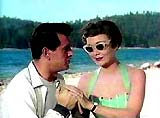
The scene in which reckless and wealthy playboy Dr. Bob Merrick (Rock Hudson) promised Helen (Jayne Wyman), the blinded widow of Dr. Wayne Phillips, www.filmsite.org/tearjerkers16.html

Magnificent Obsession (1954)

#84

The scene in which reckless and wealthy playboy Dr. Bob Merrick (Rock Hudson) promised Helen (Jayne Wyman), the blinded widow of Dr. Wayne Phillips, that he would look after her; and the scene in which Helen woke up from her successful operation and told him:

"it doesn't hurt as much".


The Yearling (1946) - IMDb user comments
The essence of the main characters is perfectly portrayed by the main leads of Gregory Peck and Jayne Wyman, but Claude Jarman Jnr as Jody has a special ... www.imdb.com/title/tt0039111/usercomments

Labels: , , ,

Thursday, July 12, 2007

Lady Bird Johnson joins her husband.

IMAGE: Lady Bird Johnson
Updated: 4:48 p.m. ET June 23, 2007 News of being admitted for tests. Expected to return home in a few days.
Her husband, former President Lyndon B. Johnson, died in 1973.

This site has a lot offered about her accomplishments and life.
Green first lady planted a movement Chron.com - Houston Chronicle
Funeral arrangements for Lady Bird Johnson, who died Wednesday at 4:18 pm, have been finalized: Friday, July 13 • Morning: Private family Eucharist at the ... www.chron.com/disp/story.mpl/front/4960783.html

Lady Bird Johnson dies at 94 - Politics - MSNBC.com
Lady Bird Johnson, the former first lady who championed conservation and worked tenaciously for the political career of her husband, former President Lyndon ... www.msnbc.msn.com/id/19717425/?GT1=10150

Lady Bird Johnson - Wikipedia, the free encyclopedia

[11] In June 2007, Johnson spent six days in Seton Hospital in Austin after ... New York Times "Lady Bird Johnson, 94, Dies; Eased a Path to Power" July 12 ...
en.wikipedia.org/wiki/Lady_Bird_Johnson - Jul 12, 2007

This article is about a recently deceased person. Some information, such as the circumstances of the person's death and surrounding events, may change rapidly as more facts become known.

lbj header

Lyndon B. Johnson: Thirty-Sixth President of the United States (1963-1969)

Answers to Frequently Asked Questions About:

Photographic Portrait of President Johnson by Frank Muto, Image D3538-3

President Johnson wearing the Silver Star lapel button on his suit. He was awarded the Silver Star medal during his service in World War II. Information on images used in FAQ


Lady Bird Johnson Images

The Early Years, 1912-1934
The Early Years, 1934-1960
The White House Years, 1963-1964

The White House Years, 1965-1967
The White House Years, 1968
The Post-Presidential Years, 1969-Present

Important Information

Image Selection: The objective of this posting is to provide a series of images that reflect the major themes and some important moments of Mrs. Johnson’s full and remarkable life. There are some voids in the collections; for example, no images of her wedding are known to exist. Many of the images appear in the photo-essay book, Lady Bird Johnson – A Life Well Lived by Harry Middleton, Director Emeritus of the Johnson Library. The Library’s Museum Store offers copies of the book for purchase.

Image Files Sized for Best Quality: As an experiment we are offering these images in file sizes larger than those found elsewhere on our site. The smaller .tif files are sized appropriately for desktop publishing at about 300 ppi. The larger files are intended for use by commercial photo labs with high-speed internet connections. The large files are too large for most home-user systems to handle and may crash them. Some Internet Service Providers automatically reject large files. To get a much smaller file (72 ppi), right-click on the image on each image’s web page, and save.

Lady Bird Johnson Photographs

The Early Years 1934 - 1960

Previous (1912-1934) Next (1963-1964)


B9798


B1621-3

41-5-12

41-6-2

41-6-84

41-6-113

B6330-2

58-8-18

59-12-91

60-7-171
Previous (1912-1934) Next (1963-1964)
Back to Introduction Page LBJ - 2313 Red River - Austin, Texas, 78705 - 512-721-0200 - Free Admission REFERENCE
LBJ Biographical Chronology
Lady Bird Johnson
Quick Facts
Heads of State Visits
Related Links
Other Interesting Sites
Museums Vietnam Federal and Local Government Research
Lady Bird Johnson Wildflower Center Lyndon Johnson National Historical Park Lyndon Johnson Memorial Grove on the Potomac LBJ School of Public Affairs: The University of Texas at Austin
LBJ Museum at San Marcos, Texas Austin Convention and Visitors Bureau
Presidential Timeline
FEDERAL AND LOCAL GOVERNMENT

Other Presidential Libraries

The White House

Johnson Space Center

Library of Congress

National Archives & Records Administration (NARA)

Archival Research Catalog (ARC)
ARC is the online catalog of NARA's nationwide holdings in the Washington, DC area, Regional Archives, and Presidential Libraries. The ARC catalog can be used to search by media type and by subject. ARC's advanced functionalities also allow you to search by organization, person, or topic.

You are now leaving the LBJ Library & Museum Web site to access:

The Lady Bird Johnson Wildflower Center

We have provided this link to an external site because it has information that may be of interest to our users. The Johnson Library and Museum does not have official ties to any of these external links and is not responsible for their content or for any problems you may have in connecting to them.

Thank you for visiting. We hope your visit to the Johnson Library and Museum site was informative and enjoyable.

Visit the Lady Bird Johnson Tribute website for memorial schedule and information.

Honor Lady Bird Johnson's memory by making a memorial contribution to
Lady Bird Johnson Wildflower Center Endowment Fund.

Read more about Lady Bird Johnson on our
biography pages.

Learn more about
Tribute Events at the Wildflower Center.

go to
Wildflower Center's home page.

About Us

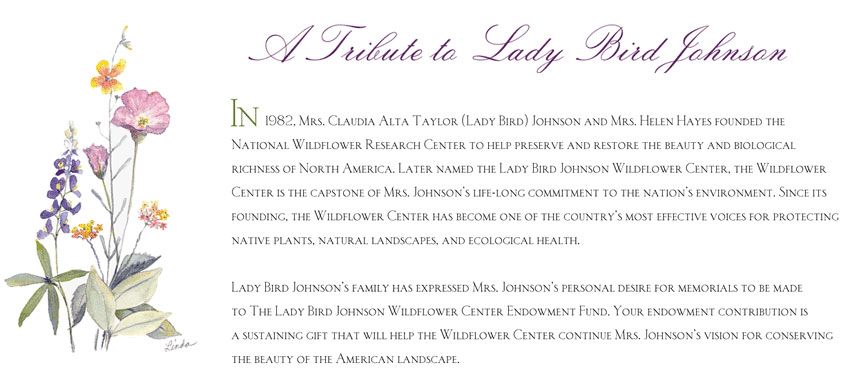
Lady Bird Johnson, our former first lady, and Actress Helen Hayes founded an organization in 1982 to protect and preserve North America's native plants and natural landscapes. First as the National Wildflower Research Center and later as the Lady Bird Johnson Wildflower Center, this special place exists to introduce people to the beauty and diversity of wildflowers and other native plants. Every day, the Wildflower Center brings life to Mrs. Johnson's vision in its public gardens, its woodlands and sweeping meadows as well as in internationally influential research. In 2006, the Center became an Organized Research Unit of the University of Texas at Austin.

Decades ago, Mrs. Johnson recognized that our country was losing its natural landscapes and its natural beauty. As much as 30 percent of the world’s native flora is at risk of extinction. The Wildflower Center was intended to help preserve and restore that beauty and the biological richness of North America. Since then, the Center has become one of the country’s most credible research institutions and effective advocates for native plants.

The Center’s gardens display the native plants of the Central Texas Hill Country while the Plant Conservation Program protects the ecological heritage of Texas by conserving its rare and endangered flora. The Native Plant Information Network is a database of more than 7,200 native species available online.

The Land Restoration Program uses the science of healing and renewing damaged and even destroyed ecological systems to restore balance to the landscape. The Center’s education programs for children and adults teach people about their natural surroundings and how to grow native plants in their own backyards.

Nature Nights

Nature Nights has been cancelled on Thursday July 12, because the Wildflower Center will be closed for memorial events.

An Evening of Fun Family Learning, Every Thursday In July

The goal of the Native Plant Information Network is to assemble and disseminate information that will encourage the cultivation, conservation, and preservation of wildflowers and other native flora throughout North America. Learn more about this project by visiting these pages: About NPIN Project Personnel NPIN Updates .

Labels: , , , , , ,