cc` !DOCTYPE html PUBLIC "-//W3C//DTD XHTML 1.0 Strict//EN" "http://www.w3.org/TR/xhtml1/DTD/xhtml1-strict.dtd"> My Dragon's Lair Sharing is the reason for my being...

My Dragon's Lair Sharing is the reason for my being...

Altered and added new content 10-4-07 Important 5-4-07 No longer Child safe because of the links inside sites included here. Adult Humor is posted here. Template errors still. E shows wrong, and Netscape shows mostly correct. Activly learning HTML to correct and improve. Be it fun or serious I hope you enjoy and take away with you what I find to share. LI

Sunday, November 04, 2007

Russian folk choreographer Moiseyev dies

Igor Moiseyev, the founder of the Moiseyev Dance Company, at a rehearsal in 1986.

By JACK ANDERSON

Igor Moiseyev, the master choreographer who created a new form of theatrical folk dance in Russia and whose troupe was one of the most popular dance companies of the 20th century, died yesterday in Moscow. He was 101. Alexander Zemlianichenko/Associated Press

Igor Moiseyev, a Russian choreographer, in 2006.

Daniel Mihailescu/Agence France-Presse — Getty Images

The company in performance in 2003.

His death, at a hospital where he had been unconscious for three days, was announced by the troupe’s director, Yelena Shcherbakova, the ITAR-Tass news agency reported. The Kremlin said that President Vladimir V. Putin expressed condolences.

The Moiseyev Dance Company’s energy, virtuosity, precision and ingenious distillation of folk styles from many lands set audiences cheering worldwide. When the troupe made its New York debut in 1958, presented by the impresario Sol Hurok at the Metropolitan Opera House, it became the first major Soviet dance group to perform in the United States. The visit helped usher in a new era of cultural exchange, formalized that year by an agreement signed by the United States and the Soviet Union.

John Martin, the dance critic of The New York Times, pronounced the New York debut “stupendous.” And Ed Sullivan gave the troupe national exposure during the same trip, presenting the dancers for a full hour on his television variety show, “Toast of the Town” (later renamed “The Ed Sullivan Show”).

Although Mr. Moiseyev’s choreography derived from folk sources, he created his works for professional dancers: as observers noted from the start, no peasants or villagers ever danced with such theatrical flair.

“Moiseyev is an astute folklorist and a good artist,” Mr. Martin wrote in 1958. “His company, 100 strong, is warm, vital, vivacious, remarkably trained, energetic beyond belief, and above all performers deluxe.”

Igor Aleksandrovich Moiseyev (pronounced moy-SAY-yeff) was born in Kiev, Ukraine, in 1906, the only child of a Russian lawyer and a French-Romanian seamstress. His family lived in Paris until he was 8, and throughout his life he spoke to Western journalists in fluent French.

After the family returned to Russia he studied ballet privately in Moscow, then entered the Bolshoi Ballet School in 1921. From 1924 to 1939 he was a member of the Bolshoi, sympathetic to the efforts of innovative Soviet choreographers of the 1920s and ’30s.

He developed his own interest in choreography, and his early ballets — among them “The Footballer” (1930), “Salammbô” (1932) and “Three Fat Men” (1935) — were noted for their experimentation, drama and characterization.

In 1936 Mr. Moiseyev was appointed dance director of the Moscow Theater of Folk Art, from which emerged, a year later, the Soviet Union’s first folk-dance ensemble. The troupe originally included many amateurs, but it soon employed professionally trained dancers. Officially known as the State Academic Folk Dance Ensemble of the Soviet Union, the troupe was usually billed in the West simply as the Moiseyev Dance Company.

Most of Mr. Moiseyev’s works were inspired by the traditions of the various regions in the Soviet Union. But he also created dances with Chinese, Cuban, Sicilian and Argentine themes, and in the early ’60s his dancers amused American audiences by performing the Virginia reel and a parody of rock ’n’ roll.

Mr. Moiseyev attributed his dancers’ virtuosity and versatility to their training in classical ballet, which he described in a 1970 interview as “the grammar of movement.”

“With ballet technique as a base,” he added, “one can do everything.”

He continued to work with traditional ballet companies throughout his career. In 1958, he staged his own version of “Spartacus” for the Bolshoi Ballet.

In addition to directing his folk ensemble, from 1967 to 1971 he headed a classical ballet troupe. Among its members were Alexander Filipov and Alexander Godunov, who both later joined American Ballet Theater in New York.

It was always Mr. Moiseyev’s folk dances that brought him international attention and acclaim. A favorite with audiences everywhere was the dramatic “Partisans,” which was both a tribute to Soviet guerrilla fighters in World War II and a technical tour de force that required dancers to imitate the gait of mounted soldiers whose “horses” were invisible under their cloaks.

The Moiseyev company consistently received critical acclaim. Yet as its repertory became familiar, the pioneering dancers of the original troupe were replaced by younger performers more concerned with technique than with motivating impulse. Reviewers began to notice limitations in the troupe’s aesthetic approach.

As a popular Soviet cultural export, the Moiseyev company was occasionally the target of American groups protesting Soviet policies. Most such demonstrations involved only picketing, but others turned violent. At a Moiseyev opening in September 1986, Russian members of the Jewish Defense League threw a tear gas canister into the audience at the Metropolitan Opera House, sending nearly 4,000 people streaming out of the hall.

Controversies also developed over the ideological content of Mr. Moiseyev’s work. Many Western critics found his happy folk to be in line with an accent on the positive required by Socialist Realism. A defender of expressive dramatic content in choreography, Mr. Moiseyev reiterated the dominant Soviet aesthetics of the cold war period when he deplored abstraction in ballet.

But Mr. Moiseyev, who refused to join the Communist Party, did more than parrot officially sanctioned views. In 1959 he was reprimanded by Soviet authorities for delivering a speech in which he maintained that American culture, far from being inherently decadent, was blessed with vigor. In 1967 he ruffled the Soviet authorities by asserting in a Pravda article that Soviet ballet was deadened by its preoccupation with princes and princesses and its unwillingness to tackle contemporary themes.

Mr. Moiseyev married the dancer Tamara Zeifert in 1940; she became his choreographic assistant. Other members of the company included their daughter, Olga Moiseyeva, and her husband, Boris Petrov. Mr. Moiseyev married a second time, and his wife is among his survivors, Ms. Shcherbakova said.

In poor health in recent years, he was rarely seen in public. But he appeared at a concert in Moscow last year to celebrate his 100th birthday. On his centenary, he received the Order of Merit, Russia’s highest civilian decoration. He had earlier been named People’s Artist of the U.S.S.R.. His other honors included the Dance Magazine Award in the United States, the Lenin Prize and three Stalin Prizes.

A creatively passionate man, Mr. Moiseyev said in a 1965 interview: “Everything I’ve done, I love. If you’re not in love, you can’t create. And if you’re calm when you’ve created something, you can rest assured that you’ve created nothing.”

Labels: , , ,

Saturday, October 20, 2007

Taku: Killer whale at SeaWorld in Texas dies

SAN ANTONIO - A killer whale at the SeaWorld in San Antonio has died unexpectedly.
SeaWorld spokesman Fran Stephenson says Taku (tah-KU'), a 14-year-old male killer whale, died Wednesday night. Taku had been showing signs of infection for the three days before his death, but he was responding to treatment, Stephenson said.
A cause of death has not been determined. Results of an examination will be available in six weeks.
Stephenson said there is a wide disparity on estimates for the life expectancy of killer whales.


Taku died unexpectedly on October 17, 2007, at the age of 14 and weighing over 7000 lbs. Authorities said that a post-mortem examination will be performed, but results will not be available for six weeks.
Taku is a male killer whale, born at SeaWorld in Florida. After birth, he spent most of his time, being with Katina or Nyar, his half-sister. After 3 years of his mothers' care, she gave birth again. When his little sister was born he was very interested and since that moment they were inseparable! Mostly Unna, Katina and Taku were in a tank, doing laps together. On August 25, 2002 Katina gave birth again.

He became nervous and had to be moved into another tank. Unna was later moved to SeaWorld Texas in December of 2002 and since then, Ikaika and Taku started bonding. Ikaika even can swim in mother-calf-position with Taku.

Family Members/Breed

(Asterisk indicates a deceased relative)

Meeting Takara: When Takara and her daughter Kohana arrived at SeaWorld, Taku took some romantic interest in her. At first, Takara would swim away from him when he was too close to him but later took romantic interest in Taku and began to be close to him. Takara had made a good impression on Taku - love at first sight! Visitors were commenting on Taku's persistence in following Takara and Kohana everywhere after their arrival. Now things have settled down a bit and Takara actually enjoys Taku's company a lot. She would often initiate contact with him by swimming with him or just rubbing. They're a cute couple. Soon Taku mated with Takara in May 2004 and she became pregnant by him.

Birth of Taku's son Trua: On November 23, 2005 around 21:50 EST (4:50 PM), Takara went into labor with her second calf with her daughter Kohana beside her. An hour later around 22:22, Takara gave birth to a male calf (Taku's son/first calf) who was later to be named Trua. Source: Wikipedia

Orcas - SeaWorld's main attraction is its Orcas, several of which are housed in 7-million-gallon habitats that are each known as Shamu Stadium. Shamu was the name of the first Orca brought to SeaWorld San Diego in the 1960s. 'Shamu' is now used as a stage name for adult Orcas in performances at SeaWorld parks. The Orcas all have real names. Currently, Sea World houses 22 Orcas in its three parks. Seven Orcas live in the San Diego park: Corky, Kasatka, Ulises, Orkid, Sumar, Nakai, and Kalia. Nine live at SeaWorld Orlando: Katina, Kalina, Tilikum, Taima, Takara, Kayla, Trua, Nalani, and Malia. SeaWorld San Antonio holds six Orcas: Taku, Kyuquot, Keet, Unna, Tuar, and Halyn. Wikipedia History of SeaWorld

Dedicated to Taku on Webshots.com Taku published by orcalover109 Rest In Peace, Taku . . . I've uploaded some old pictures I had of Taku. I apologize for any duplicates. I chose this one for the dedication given. Photos and comments posted.

From Texas Liberal, a Wordpress Political site. The highlighted links show what is included.

An orca, or killer whale, has died unexpectedly today at Sea World in San Antonio, Texas. This whale was called Taku.

Taku is an interesting name for this whale. Gyotaku is a Japanese art form where an impression in paper made over a dead fish in order to preserve an image of the fish. In this way, fishermen could prove how big a catch they had made to others. It is also practiced by some as an art form.

The photo above is gyotaku art. Gyo means “fish” and taku means “rubbing or “impression.”

Of course, gyotaku is not what Sea World is doing with the deceased so-called Taku. Everybody already knows that Sea World puts huge killer whales in little tanks. Nothing to prove on that account.

Please click here for a previous Texas Liberal post on what is done with Shamu whales when they die at Sea World.

Please click here for a post on when a Shamu attacked her handler.

About Author: Neil Aquino. Since you’re at a political blog, please click here for a great article on helping America’s middle classes. We’ve got to find a way to help people live decent lives in the Global Economy. October 19th, 2007 - Posted by Neil Aquino Art, Sea Life, Texas , , , , , ,

Labels: , , , , ,

Sunday, September 16, 2007

Explorer who found lost Peru cities dies

RENO, Nev. - Douglas Eugene "Gene" Savoy, an explorer who discovered more than 40 lost cities in Peru and led long-distance sailing adventures to learn more about ancient cultures, has died. He was 80.

Savoy died of natural causes Tuesday at his Reno home, his family said Saturday.

Dubbed the "real Indiana Jones" by People magazine, Savoy was credited with finding four of Peru's most important archaeological sites, including Vilcabamba, the last refuge of the Incas from the Spanish Conquistadors.

Hiram Bingham considered Machu Picchu to be the site of Vilcabamba after he discovered it in 1911 in the Peruvian Andes. But scientific consensus now points toward Espiritu Pampa as the Incas' last stronghold; Bingham also discovered that site but Savoy's excavation work in the mid-1960s found it to be a much larger settlement than originally realized.

In the next 40 years in the jungles of Peru, Savoy discovered more than 40 stone cities of a mysterious pre-Inca civilization known as the Chachapoyas. Among them were Gran Pajaten, Gran Vilaya and Gran Saposoa.

"Scientists thought the existence of these cities and settlements in the Peruvian rainforest was all a myth until my father found them," his son Sean Savoy said. "His discoveries opened up a whole new area of jungle archaeology that didn't exist before."

He said his father suffered hepatitis, was bitten by snakes and chased by guerrilla soldiers during his explorations.

Savoy also took to the sea to test his theories that the Incas, Aztecs and other ancient civilizations had contact with each other. From 1977 to 1982, he used a 60-foot schooner to research possible trade routes in the Atlantic and Pacific oceans.

Savoy wrote dozens of books, including 1970's "Antisuyo: The Search for the Lost Cities of the Amazon" about his early discoveries in Peru, and 1974's "On the Trail of the Feathered Serpent" about some of his sea journeys.

But the bulk of his books and articles concerned another consuming passion: religion.

As founder of a new theology known as "Cosolargy," he established the International Community of Christ, Church of the Second Advent. He taught that the Second Coming of Christ had already become a living reality through a miraculous celestial event.

Savoy was born in Bellingham, Wash., and served as a Navy gunner during World War II. He later was a journalist and newspaper editor in Portland, Ore.

He moved to Reno in 1971 and founded the Andean Explorers Foundation & Ocean Sailing Club based in that city. The nonprofit organization sponsored many of his explorations.

Among other awards, he was honored with medals from the Peruvian Senate and the Peruvian Ministry of Industry and Tourism in the late 1980s. The city of Reno proclaimed "Gene Savoy Day" in October 1996.

Survivors include his children, Gene Jr., Sean and Sylvia Jamila Savoy, and three granddaughters.

By MARTIN GRIFFITH, Associated Press Writer Sun Sep 16, 2:44 AM ET

Andean Explorers Foundation & Ocean Sailing Club (AEFOSC)
Dedicated to the advancement of historical field and oceanic research through exploration in little-known areas around the world. www.aefosc.org/

Due to strict Copyright © I have only given link. Enjoy. You'll find that his death has not yet been posted. And here are a few errors to links. Though you will find cool stuff as far as the adventures.

This Web site, www.aefosc.org, is a project of the AEF & OSC Publishing Department.Senior Webmaster: Sean SavoyCopyright © 1998-2004 Andean Explorers Foundation & Ocean Sailing Club. All rights reserved. The AEF & OSC is a not-for-profit organization as defined under Section 501 (c)(3) of the Internal Revenue Code. "Andean Explorers Foundation & Ocean Sailing Club", "Spirit of Exploration", "The Compass Rose", the Seal, Flag and Pennant, and all other logos are trademarks. Use by others is strictly prohibited. Photographs appearing on this site are taken from AEF & OSC archives or othewise used by permission, and may not be copied or re-used in any manner. LEGAL NOTICE

Labels: , , , , , , ,

Monday, September 10, 2007

`Johnny Belinda' actress Jane Wyman dies

Actors Jane Wyman and Ronald Reagan hold their 9-month-old daughter Maureen Elizabeth, on Sept. 13, 1941, at their home in Hollywood, Calif. Wyman, an Academy Award winner for her performance as the deaf rape victim in 'Johnny Belinda,' star of the long-running TV series 'Falcon Crest' and Ronald Reagan's first wife, died Monday morning, Sept. 10, 2007 at 93.  (AP Photo)

AP Photo: Actors Jane Wyman and Ronald Reagan hold their 9-month-old daughter Maureen Elizabeth, on Sept. 13By BOB THOMAS, Associated Press Writer 18 minutes ago

LOS ANGELES - Jane Wyman, an Academy Award winner for her performance as the deaf rape victim in "Johnny Belinda," star of the long-running TV series "Falcon Crest" and Ronald Reagan's first wife, died Monday morning at 93.

ADVERTISEMENT

Wyman died at her Palm Springs home, said Richard Adney of Forest Lawn Memorial Park and Mortuary in Cathedral City. No other details were immediately available.

Wyman's film career spanned from the 1930s, including "Gold Diggers of 1937," to 1969's "How to Commit Marriage," co-starring Bob Hope and Jackie Gleason. From 1981 to 1990 she played Angela Channing, a Napa Valley winery owner who maintained her power with a steely will on CBS' "Falcon Crest."

Her marriage in 1940 to fellow Warner Bros. contract player Reagan was celebrated in the fan magazines as one of Hollywood's ideal unions. While he was in uniform during World War II, her career ascended, signaled by her 1946 Oscar nomination for "The Yearling."

The couple divorced in 1948, the year she won the Oscar for "Johnny Belinda." Reagan reportedly cracked to a friend: "Maybe I should name Johnny Belinda as co-respondent."

After Reagan became governor of California and then president of the United States, Wyman kept a decorous silence about her ex-husband, who had married actress Nancy Davis. In a 1968 newspaper interview, Wyman explained the reason:

"It's not because I'm bitter or because I don't agree with him politically. I've always been a registered Republican. But it's bad taste to talk about ex-husbands and ex-wives, that's all. Also, I don't know a damn thing about politics."

A few days after Reagan died on June 5, 2004, Wyman broke her silence, saying: "America has lost a great president and a great, kind and gentle man."

It was 1936 when Warner Bros. signed Wyman to a long-term contract. She long remembered the first line she spoke as a chorus girl to show producer Dick Powell: "I'm Bessie Fuffnik. I swim, ride, dive, imitate wild birds and play the trombone."

Warner Bros. was notorious for typecasting its contract players, and Wyman suffered that fate. She recalled in 1968: "For 10 years I was the wisecracking lady reporter who stormed the city desk snapping, `Stop the presses! I've got a story that will break this town wide open!'"

In 1937, Wyman married a wealthy manufacturer of children's clothes, Myron Futterman, in New Orleans. The marriage was reported as her second, but an earlier marriage was never confirmed. She divorced him in November 1938, declaring she wanted children and he didn't.

The actress became entranced by Reagan, a handsome former sportscaster who was a newcomer to the Warner lot. She wangled a date with him, and romance ensued.

After returning from a personal appearance tour with columnist Louella Parsons, they were married on Jan. 26, 1940. The following year she gave birth to a daughter, Maureen. They later adopted a son, Michael. They also had a daughter who was born several months premature in June 1947 and died a day later.

In Reagan's autobiography "An American Life," the index shows only one mention of Wyman, and it runs for only two sentences. "That same year I made the Knute Rockne movie, I married Jane Wyman, another contract player at Warners," Reagan wrote. "Our marriage produced two wonderful children, Maureen and Michael, but it didn't work out, and in 1948 we were divorced." The final divorce decree was issued in 1949.

Their daughter Maureen died in August 2001 after a battle with cancer. At the funeral, Wyman, balancing on a cane, put a cross on the casket. Reagan, suffering from Alzheimer's disease, was not well enough to attend.

Early in their marriage, Reagan's career grew with "Knute Rockne — All American" and "King's Row" while Wyman languished as "Joan Blondell of the B's." That changed after Reagan joined the army.

Wyman escaped B-pictures by persuading Jack Warner to loan her to Paramount for "The Lost Weekend." The film won the Academy Award for 1945 and led to another loanout — to MGM for "The Yearling." De-glamourized as a backwoods wife and mother, the actress received her first Oscar nomination.

After 40 films at Warner Bros., Wyman achieved her first acting challenge with "Johnny Belinda." When Jack Warner saw a rough cut of the film, he ranted to the director, Jean Negulesco: "We invented talking pictures, and you make a picture about a deaf and dumb girl!"

He changed his attitude when "Johnny Belinda" received 12 Academy Award nominations and the Oscar for Jane Wyman.

Her acceptance speech was brief: "I accept this award very gratefully for keeping my mouth shut once. I think I'll do it again."

Reagan became increasingly active in politics as his wife's career climbed. When she divorced him, she testified: "Politics built a barrier between us. I tried to make his interests mine, but finally there was nothing to sustain our marriage."

Wyman continued making prestigious films such as "The Glass Menagerie," Alfred Hitchcock's "Stage Fright," "Here Comes the Groom" (with Bing Crosby). Two tearjerkers, "The Blue Veil" (1951) and "Magnificent Obsession" (1954), brought her Oscar nominations as best actress.

Other film credits include: "So Big," "Lucy Gallant," "All That Heaven Allows," "Miracle in the Rain," "Holiday for Lovers," "Pollyanna" and "Bon Voyage!"

Her first entry into television came with "The Jane Wyman Show," an anthology series that appeared on NBC from 1955 to 1958. She introduced the shows, half of them starring herself, half with other actors. She quit the show after three years, saying that "putting on a miniature movie once a week" was exhausting.

In 1952 Wyman married Fred Karger, a studio music director. They divorced, later remarried and divorced the second time in 1965. She remained single thereafter. While not working, she devoted much of her time to benefits and telethons for the Arthritis Foundation.

When Wyman received the script for "Falcon Crest," she was undecided about undertaking the nasty, power-mad Angela Channing, so different from the self-sacrificing characters of her movie days.

But she liked the idea that Angela "runs everything. She goes straight through everything like a Mack truck."

Riding the wave of prime-time soap operas that made "Dallas" and "Dynasty" national sensations, "Falcon Crest" lasted nine seasons. The series ended with Angela again in control of the vineyard. Her battered family raised their glasses in a toast: "The land endures."

After Reagan became president in 1981, his former wife gave few interviews and responded to questions about him with a stony look. When "Falcon Crest" ended, she withdrew from public view. She saw a few intimates and devoted much time to painting.

She summed up her long career in a 1981 newspaper interview: "I've been through four different cycles in pictures: the brassy blonde, then came the musicals, the high dramas, then the inauguration of television."

In the end, she had survived for decades in a town notorious for exploiting talent and then discarding it.

Sarah Jane Fulks was born in St. Joseph, Mo., in 1914. She grew up in a cheerless home in which her mother's time was devoted to her seriously ailing husband. After the father died, Sarah Jane accompanied her mother to Los Angeles, where the girl tried to get jobs in the studios. There was no work for the snub-nosed teenager, and she returned to St. Joseph.

She attended the University of Missouri, worked as a manicurist and switchboard operator, then sang on radio as Jane Durrell. When that career dwindled, she decided to try Hollywood again, began playing bit parts, and changed Durrell to Wyman.

7Online.com: US and World News from WABC-TV
Jane Wyman, an Academy Award winner for her performance as the deaf rape victim in. ... Jayne Wyman dies at 93. Wynman was Ronald Regan's first wife. WABC ...
abclocal.go.com/wabc/story?section=nation_world&id=5650360

- Jane Wyman, an Academy Award winner for her performance as the deaf rape victim in "Johnny Belinda," star of the long-running TV series "Falcon Crest" and Ronald Reagan's first wife, died Monday morning at 93.

Wyman died at her Palm Springs home, said Richard Adney of Forest Lawn Memorial Park and Mortuary in Cathedral City. No other details were immediately available.

Wyman's film career spanned from the 1930s, including "Gold Diggers of 1937," to 1969's "How to Commit Marriage," co-starring Bob Hope and Jackie Gleason. From 1981 to 1990 she played Angela Channing, a Napa Valley winery owner who maintained her power with a steely will on "Falcon Crest."

Her marriage in 1940 to fellow Warner Bros. contract player Reagan was celebrated in the fan magazines as one of Hollywood's ideal unions. While he was in uniform during World War II, her career ascended, signaled by her 1946 Oscar nomination for "The Yearling."

The couple divorced in 1948, the year she won the Oscar for "Johnny Belinda." Reagan reportedly cracked to a friend: "Maybe I should name Johnny Belinda as co-respondent."

After Reagan became governor of California and then president of the United States, Wyman kept a decorous silence about her ex-husband, who had married actress Nancy Davis. In a 1968 newspaper interview, Wyman explained the reason:

"It's not because I'm bitter or because I don't agree with him politically. I've always been a registered Republican. But it's bad taste to talk about ex-husbands and ex-wives, that's all. Also, I don't know a damn thing about politics."

A few days after Reagan died on June 5, 2004, Wyman broke her silence, saying: "America has lost a great president and a great, kind and gentle man." ms - Scenes and Moments

Greatest Tearjerkers Films:
The scene in which reckless and wealthy playboy Dr. Bob Merrick (Rock Hudson) promised Helen (Jayne Wyman), the blinded widow of Dr. Wayne Phillips, www.filmsite.org/tearjerkers16.html

Magnificent Obsession (1954)

#84

The scene in which reckless and wealthy playboy Dr. Bob Merrick (Rock Hudson) promised Helen (Jayne Wyman), the blinded widow of Dr. Wayne Phillips, that he would look after her; and the scene in which Helen woke up from her successful operation and told him:

"it doesn't hurt as much".


The Yearling (1946) - IMDb user comments
The essence of the main characters is perfectly portrayed by the main leads of Gregory Peck and Jayne Wyman, but Claude Jarman Jnr as Jody has a special ... www.imdb.com/title/tt0039111/usercomments

Labels: , , ,

Thursday, July 12, 2007

Lady Bird Johnson joins her husband.

IMAGE: Lady Bird Johnson
Updated: 4:48 p.m. ET June 23, 2007 News of being admitted for tests. Expected to return home in a few days.
Her husband, former President Lyndon B. Johnson, died in 1973.

This site has a lot offered about her accomplishments and life.
Green first lady planted a movement Chron.com - Houston Chronicle
Funeral arrangements for Lady Bird Johnson, who died Wednesday at 4:18 pm, have been finalized: Friday, July 13 • Morning: Private family Eucharist at the ... www.chron.com/disp/story.mpl/front/4960783.html

Lady Bird Johnson dies at 94 - Politics - MSNBC.com
Lady Bird Johnson, the former first lady who championed conservation and worked tenaciously for the political career of her husband, former President Lyndon ... www.msnbc.msn.com/id/19717425/?GT1=10150

Lady Bird Johnson - Wikipedia, the free encyclopedia

[11] In June 2007, Johnson spent six days in Seton Hospital in Austin after ... New York Times "Lady Bird Johnson, 94, Dies; Eased a Path to Power" July 12 ...
en.wikipedia.org/wiki/Lady_Bird_Johnson - Jul 12, 2007

This article is about a recently deceased person. Some information, such as the circumstances of the person's death and surrounding events, may change rapidly as more facts become known.

lbj header

Lyndon B. Johnson: Thirty-Sixth President of the United States (1963-1969)

Answers to Frequently Asked Questions About:

Photographic Portrait of President Johnson by Frank Muto, Image D3538-3

President Johnson wearing the Silver Star lapel button on his suit. He was awarded the Silver Star medal during his service in World War II. Information on images used in FAQ


Lady Bird Johnson Images

The Early Years, 1912-1934
The Early Years, 1934-1960
The White House Years, 1963-1964

The White House Years, 1965-1967
The White House Years, 1968
The Post-Presidential Years, 1969-Present

Important Information

Image Selection: The objective of this posting is to provide a series of images that reflect the major themes and some important moments of Mrs. Johnson’s full and remarkable life. There are some voids in the collections; for example, no images of her wedding are known to exist. Many of the images appear in the photo-essay book, Lady Bird Johnson – A Life Well Lived by Harry Middleton, Director Emeritus of the Johnson Library. The Library’s Museum Store offers copies of the book for purchase.

Image Files Sized for Best Quality: As an experiment we are offering these images in file sizes larger than those found elsewhere on our site. The smaller .tif files are sized appropriately for desktop publishing at about 300 ppi. The larger files are intended for use by commercial photo labs with high-speed internet connections. The large files are too large for most home-user systems to handle and may crash them. Some Internet Service Providers automatically reject large files. To get a much smaller file (72 ppi), right-click on the image on each image’s web page, and save.

Lady Bird Johnson Photographs

The Early Years 1934 - 1960

Previous (1912-1934) Next (1963-1964)


B9798


B1621-3

41-5-12

41-6-2

41-6-84

41-6-113

B6330-2

58-8-18

59-12-91

60-7-171
Previous (1912-1934) Next (1963-1964)
Back to Introduction Page LBJ - 2313 Red River - Austin, Texas, 78705 - 512-721-0200 - Free Admission REFERENCE
LBJ Biographical Chronology
Lady Bird Johnson
Quick Facts
Heads of State Visits
Related Links
Other Interesting Sites
Museums Vietnam Federal and Local Government Research
Lady Bird Johnson Wildflower Center Lyndon Johnson National Historical Park Lyndon Johnson Memorial Grove on the Potomac LBJ School of Public Affairs: The University of Texas at Austin
LBJ Museum at San Marcos, Texas Austin Convention and Visitors Bureau
Presidential Timeline
FEDERAL AND LOCAL GOVERNMENT

Other Presidential Libraries

The White House

Johnson Space Center

Library of Congress

National Archives & Records Administration (NARA)

Archival Research Catalog (ARC)
ARC is the online catalog of NARA's nationwide holdings in the Washington, DC area, Regional Archives, and Presidential Libraries. The ARC catalog can be used to search by media type and by subject. ARC's advanced functionalities also allow you to search by organization, person, or topic.

You are now leaving the LBJ Library & Museum Web site to access:

The Lady Bird Johnson Wildflower Center

We have provided this link to an external site because it has information that may be of interest to our users. The Johnson Library and Museum does not have official ties to any of these external links and is not responsible for their content or for any problems you may have in connecting to them.

Thank you for visiting. We hope your visit to the Johnson Library and Museum site was informative and enjoyable.

Visit the Lady Bird Johnson Tribute website for memorial schedule and information.

Honor Lady Bird Johnson's memory by making a memorial contribution to
Lady Bird Johnson Wildflower Center Endowment Fund.

Read more about Lady Bird Johnson on our
biography pages.

Learn more about
Tribute Events at the Wildflower Center.

go to
Wildflower Center's home page.

About Us

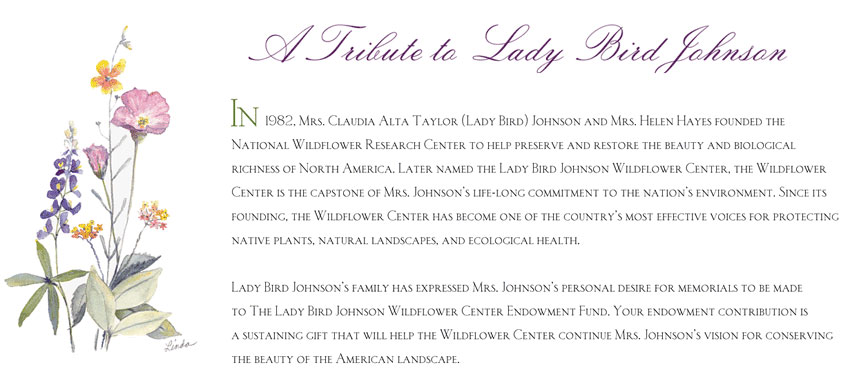
Lady Bird Johnson, our former first lady, and Actress Helen Hayes founded an organization in 1982 to protect and preserve North America's native plants and natural landscapes. First as the National Wildflower Research Center and later as the Lady Bird Johnson Wildflower Center, this special place exists to introduce people to the beauty and diversity of wildflowers and other native plants. Every day, the Wildflower Center brings life to Mrs. Johnson's vision in its public gardens, its woodlands and sweeping meadows as well as in internationally influential research. In 2006, the Center became an Organized Research Unit of the University of Texas at Austin.

Decades ago, Mrs. Johnson recognized that our country was losing its natural landscapes and its natural beauty. As much as 30 percent of the world’s native flora is at risk of extinction. The Wildflower Center was intended to help preserve and restore that beauty and the biological richness of North America. Since then, the Center has become one of the country’s most credible research institutions and effective advocates for native plants.

The Center’s gardens display the native plants of the Central Texas Hill Country while the Plant Conservation Program protects the ecological heritage of Texas by conserving its rare and endangered flora. The Native Plant Information Network is a database of more than 7,200 native species available online.

The Land Restoration Program uses the science of healing and renewing damaged and even destroyed ecological systems to restore balance to the landscape. The Center’s education programs for children and adults teach people about their natural surroundings and how to grow native plants in their own backyards.

Nature Nights

Nature Nights has been cancelled on Thursday July 12, because the Wildflower Center will be closed for memorial events.

An Evening of Fun Family Learning, Every Thursday In July

The goal of the Native Plant Information Network is to assemble and disseminate information that will encourage the cultivation, conservation, and preservation of wildflowers and other native flora throughout North America. Learn more about this project by visiting these pages: About NPIN Project Personnel NPIN Updates .

Labels: , , , , , ,

Tuesday, July 03, 2007

Beverly Sills Remembered

This is sad to hear. She was so good with sharing the love of the arts, Opera. I saw her speak introducing different opera's and it showed she loved what she was doing. And wanted us to love it too. And I recall her fight to keep the Met.

It is sad to know but I am glad that every one knows about this loss. There is no lack of available information on her work and life. I think this time I will not look at the media as the baracuda I usually do for sad times in Life when Death is announced. And knowing a little about Lung Cancer I am sure she is at peace and in no more pain.

We remember and keep those we love and admire alive by speaking of them, telling others about them. They are not forgotten. And with the mass medias we have now it is not likely they are written in a book put on a shelf and forgotten and later burned by the library to replace with new books. Her name should always pop up in a search connected with opera! Me.

ARTS


Times Topics: Beverly Sills
Complete coverage of the opera singer's life and career, including clips of her performances.
Obituary

Beverly Sills, the All-American Diva, Is Dead at 78

Justin Lane for The New York Times

Beverly Sills in 2002, after coming out of retirement as chairwoman of Lincoln Center to lead the Metropolitan Opera. More Photos >

Beverly Sills, the acclaimed Brooklyn-born coloratura soprano who was more popular with the American public than any opera singer since Enrico Caruso, even among people who never set foot in an opera house, died last night at her home in Manhattan. She was 78.

Related Her Voice on Record (July 3, 2007)

Times Topics: Beverly Sills Additional articles about the former opera singer and audio and video clips of her performances.

Audio Clips of Beverly Sills performing:
Manon: 'Un mot, s'il vous plait, Chevalier' with the Ambrosian Opera Chorus and New Philharmonia Orchestra (mp3)
'The Ballad of Baby Doe:' with Emerson Buckley and New York City Opera Orchestra (mp3)

AP Photo/G. Paul Burnett

Beverly Sills takes her final bows at the New York City Opera when she retired from the stage on Oct. 27, 1980. More Photos »

The cause was inoperable lung cancer, said her personal manager, Edgar Vincent.

Ms. Sills was America’s idea of a prima donna. Her plain-spoken manner and telegenic vitality made her a genuine celebrity and an invaluable advocate for the fine arts. Her life embodied an archetypal American story of humble origins, years of struggle, family tragedy and artistic triumph.

During her day, American opera singers routinely went overseas for training and professional opportunities. But Ms. Sills was a product of her native country and did not even perform in Europe until she was 36. At a time when opera singers regularly appeared as guests on “The Tonight Show Starring Johnny Carson,” Ms. Sills was the only opera star who was invited to be guest host. She made frequent television appearances with Carol Burnett, Danny Kaye and even the Muppets.

Indeed, while she was still singing, and before her 10-year tenure as general director of the New York City Opera, Ms. Sills for nearly two years was host of her own weekly talk show on network television. After leaving her City Opera post, she continued an influential career as an arts administrator, becoming the chairwoman first of Lincoln Center and then of the Metropolitan Opera.

During her performing career, with her combination of brilliant singing, ebullience and self-deprecating humor, Ms. Sills demystified opera — and the fine arts in general — in a way that a general public audience responded to. Asked about the ecstatic reception she received when she made a belated debut at La Scala in Milan in 1969, Ms. Sills told the press, “It’s probably because Italians like big women, big bosoms and big backsides.”

Along with Maria Callas and Joan Sutherland, she was an acknowledged exponent of the bel canto Italian repertory during the period of its post-World War II revival. Though she essentially had a light soprano voice, her sound was robust and enveloping. In her prime her technique was exemplary. She could dispatch coloratura roulades and embellishments, capped by radiant high D’s and E-flat’s, with seemingly effortless agility. She sang with scrupulous musicianship, rhythmic incisiveness and a vivid sense of text.

Moreover, she brought unerring acting instincts to her portrayals of tragic leading roles in Donizetti’s “Lucia di Lammermoor” and “Anna Bolena,” Bellini’s “Puritani,” Massenet’s “Manon” and many other operas in her large repertory. And few singers matched her deadpan comic timing and physical nimbleness in lighter roles like Rosina in Rossini’s “Barbiere di Siviglia,” whom Ms. Sills portrayed as a ditsy yet determined young woman, and Marie, the tomboylike heroine raised by a military regiment in Donizetti’s “Fille du Régiment.”

In 1955 Ms. Sills joined the New York City Opera, which then performed in the City Center building on West 55th Street. Her loyal commitment to what at the time was an enterprising but second-tier company may have prevented her from achieving wider success earlier in her career. By the time Ms. Sills finally captured international attention, her voice had started to decline.

As early as 1970, reviews of her work were mixed. Harold C. Schonberg, then the chief music critic of The New York Times, fretted in his columns about Ms. Sills’s inconsistency. Yet reviewing her as Donizetti’s Lucia at the City Opera in early 1970, Mr. Schonberg wrote: “The amazing thing about her Lucia is not so much the way she sings it, though that has moments of incandescent beauty, but the way she manages to make a living, breathing creature of the unhappy girl.” He added that Ms. Sills “delivered by far the most believable mad scene I have ever seen in any opera house.”

That fall Mr. Schonberg’s quite negative review of Ms. Sills’s singing as Queen Elizabeth I in Donizetti’s “Roberto Devereux” was strongly countered by other critics, notably Alan Rich in New York magazine. Mr. Rich reported that he had left the performance “in a state of euphoria bordering on hysteria.” A magnificent opera, he added, had been “rescued from oblivion and accorded superb treatment.” It was an “extraordinary accomplishment” for Ms. Sills, he felt.

For the rest of her singing career, Ms. Sills elicited divergent reactions from critics. But the public, by and large, adored her. Though most of her fans knew that her struggle to the top had been long and tough, few realized just how long and how tough.

An Early Start

Beverly Sills was born Belle Silverman on May 25, 1929, in the Crown Heights section of Brooklyn. Her father, Morris, was an insurance broker whose family had emigrated from Bucharest, Romania. Her mother, Shirley, was born Sonia Markovna in the Russian city of Odessa. Ms. Sills was nicknamed Bubbles at birth because, her mother said, she emerged from the womb with bubbles in her mouth, and the name stuck.

Pages 1, 2 , 3 , 4 ,

Related searches Opera - Classical Music - Music - New York City Opera

Beverly Sills Multimedia Slide Show

Remembering Beverly Sills

Images of the life and career of Beverly Sills. More Multimedia »

Video of Beverly Sills (YouTube.com)

A scene from'Il Barbiere Di Siviglia'

Beverly Sills as Queen Elizabeth Beverly Sills as Baby Doe A scene from "Manon"

Interview: Separation From Family"

Audio Clips of Beverly Sills in Performance


Manon: 'Un mot, s'il vous plait, Chevalier' with the Ambrosian Opera Chorus and New Philharmonia Orchestra (mp3)

'The Ballad of Baby Doe:' with Emerson Buckley and New York City Opera Orchestra (mp3)

Video of Beverly Sills (YouTube.com)

A scene from'Il Barbiere Di Siviglia'

Beverly Sills as Queen Elizabeth

Beverly Sills as Baby Doe

A scene from "Manon"

Interview: Separation From Family"

AP Photo/Wyatt Counts

Beverly Sills, the acclaimed Brooklyn-born coloratura soprano who was more popular with the American public than any opera singer since Enrico Caruso, even among people who never set foot in an opera house, died on July 2 at her home in Manhattan. The cause was inoperable lung cancer, said her personal manager, Edgar Vincent. She was 78.

Ms. Sills was America's idea of a prima donna. Her plain-spoken manner and telegenic vitality made her a genuine celebrity and an invaluable advocate for the fine arts. Her life embodied an archetypal American story of humble origins, years of struggle, family tragedy and artistic triumph.

At a time when American opera singers routinely went overseas for training and professional opportunities, Ms. Sills was a product of her native country and did not even perform in Europe until she was 36. At a time when opera singers regularly appeared as guests on "The Tonight Show Starring Johnny Carson," Ms. Sills was the only opera star who was invited to be guest host. She made frequent television appearances with Carol Burnett, Danny Kaye and even the Muppets. --Anthony Tommasini

ARTICLES ABOUT BEVERLY SILLS - More articles in Topics in the New York Times that were written on Beverly Sills. Includes many other people too as she affected many others. Remembering Beverly Sills Times Select Content Peter B. Greenough, 89, Former Columnist - Peter B. Greenough was a former financial columnist for The Boston Globe and the husband of the opera star Beverly Sills.September 8, 2006 Obituaries Obituary

MORE ON BEVERLY SILLS AND: NEWSPAPERS, BIOGRAPHICAL INFORMATION, DEATHS (OBITUARIES), GREENOUGH, PETER B, BOSTON GLOBE, MANHATTAN (NYC)

Times Select Content Sills Is Asking the Public to Help

Times Select Content From the Philharmonic, Relief for Louisiana Colleagues By DANIEL J. WAKIN
The New York Philharmonic will entwine itself with the Louisiana Philharmonic Orchestra in a concert to support musicians affected by Hurricane Katrina.
October 28, 2005 Movies News
Save Met Broadcasts By ROBIN POGREBIN After losing a longtime corporate sponsor, the Met and its chairwoman, Beverly Sills, will make an appeal for help on the air this weekend. March 6, 2004 Arts News

MORE ON BEVERLY SILLS AND: PHILANTHROPY, RADIO, OPERA, CHEVRONTEXACO CORPORATION, CHEVRONTEXACO CORP, METROPOLITAN OPERA

Bubbly soprano Beverly Sills, 78 - 5 hours ago

By Chris Pasles AP Beverly Sills sings the role of Norina in Donizetti's "Don Pasquale," at ... Beverly Sills, whose sparkling coloratura soprano and warm, ...

Obituary Bubbly soprano Beverly Sills, 78 By Chris Pasles Los Angeles Times

Enlarge this photo

AP

Beverly Sills sings the role of Norina in Donizetti's "Don Pasquale," at the Metropolitan Opera in New York in 1980.

Beverly Sills, whose sparkling coloratura soprano and warm, spunky personality made her an international opera celebrity and whose experience as a mother made her a passionate advocate for children with special needs, has died. She was 78.

Ms. Sills, who never smoked, died Monday of lung cancer at her home in New York, according to her longtime manager, Edgar Vincent.

The Brooklyn-born Ms. Sills, widely known as "Bubbles," was an American success story. She rose to stardom without receiving what was considered mandatory: training in Europe. Moreover, she made her career essentially outside the sacred portals of the Metropolitan Opera in New York, paving the way for generations of wholly U.S.-trained singers to succeed without Met certification.

Her repertoire eventually encompassed more than 70 roles, and she recorded 18 full-length operas and several solo recital discs. Her "Manon" received the Edison Award for best operatic album of 1971, and her Victor Herbert album won a Grammy Award in 1978.

Ms. Sills also gave opera a human face through television appearances, displaying the optimism, wit and lack of diva temperament that endeared her to general audiences as much as her technically accomplished, emotional and insightful dramatic interpretations won the affection of opera aficionados.

Reviewing her performance in the title role of "Manon" for the New Yorker in 1969, critic Winthrop Sargeant wrote: "If I were recommending the wonders of New York to a tourist, I would place Beverly Sills at the top of the list — way ahead of such things as the Statue of Liberty and the Empire State Building."

Singing, in fact, was only the first, if the longest, part of her career.

When Ms. Sills retired from the stage at 50, she spent a decade as an exceptionally capable administrator of New York City Opera, turning around the financially beleaguered company that gave her a career and to which she remained faithful as her reputation soared.

Later, she assumed the volunteer post of chairwoman of Lincoln Center in New York, which she held from 1994 to 2002, and then accepted the volunteer post of chairwoman of the Metropolitan Opera. In both positions, she proved a master fundraiser.

Spurred by the births of a daughter who is deaf and a son who is autistic, Ms. Sills also served for many years as chairwoman of the March of Dimes Foundation. Ms. Sills is survived by her daughter, Meredith, and son, Peter. Copyright © 2007 The Seattle Times Company

Beverly Sills - Wikipedia, the free encyclopedia
Beverly Sills (May 25, 1929 – July 2, 2007), born Belle Miriam Silverman, was perhaps the best-known American opera singer in the 1960s and 1970s. ...
en.wikipedia.org/wiki/Beverly_Sills - Jul 3, 2007

Great Performances . Beverly Sills: Made in America PBS

Firsthand interviews with the soprano and excerpts from her memorable performances chronicle her rise to fame on the opera stage. www.pbs.org/wnet/gperf/shows/beverlysills/index.html

Beverly Sills
Beverly Sills' greatness and recognition as a coloratura soprano and as a director of an opera company is the epitome of the American success story. ... www.jewishvirtuallibrary.org/jsource/biography/Sills.html

Beverly Sills Quotes - The Quotations Page
Beverly Sills; I've always tried to go a step past wherever people ... Beverly Sills; You may be disappointed if you fail, but you are doomed if you don't ... www.quotationspage.com/quotes/Beverly_Sills/

WIC Biography - Beverly Sills
Beverly Sills is known world over for her operatic talent. For over thirty years, she thrilled audiences with her beautiful voice and stage presence. ... www.wic.org/bio/bsills.htm

Labels: , , ,